The language is leaving me in silence
Hello,
I, like language, have left you in silence. I used to be lunatic prolific. And then I had to read a million books. And then I had to start growing a baby. Sorry!!
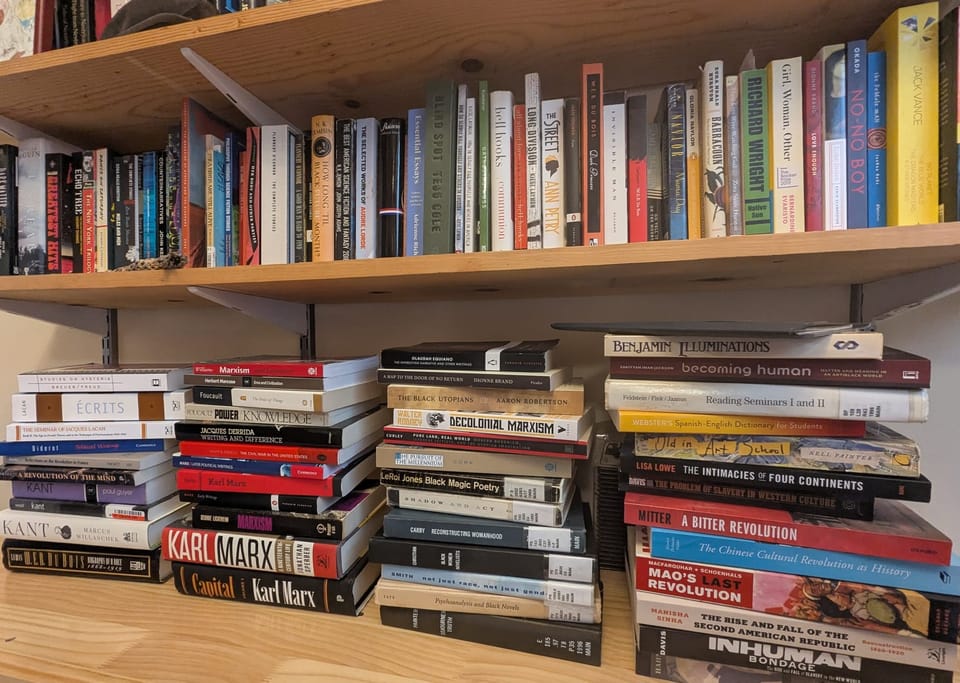
Since the last time we spoke–in that magical way of speaking across time and space, mostly soundless–I read so many books. A strange and unexpected thing is that I ended this process loving books even more than I did before. Their tediousness. Their immediately-out-dateness. Their solid, physical bookliness. Their absolute incontrovertible evidenciness of the time their writers spent thinking and writing them! Speaking of time, of course, when I say "read," I don't really mean read. I mean massacred, pillaged, desecrated. Except for the novels–mostly I read those cover to cover. A beautiful thing about stories: they do resist being read efficiently, first chapter, last chapter, chunk in the middle–he threw who down the airshaft? Still alive?! What?? Academic reading is so rude to writers.
What also surprised me about reading this list, somewhat mechanically, very efficiently, was the number of times I found myself–in the main, bored with words, disenchanted by ideas, but dutifully ingesting them, gobble gobble–delighted despite myself by a sentence, or a thought, or a character, an entire book. A reminder that in this era in which writing is becoming ever more literally the chewed and partially digested vomit of everything that has already been thought and written, you can, by reading widely, find writers who aspire, like Kiese Laymon, to
discover things I don't understand, discover different ways into things I do understand...to communicate that discovery to people with some sort of profundity.
Anyways, here are ten eleven books (that I read for the first time), that–either through language, or formal innovation, or academic intervention, or just a sentence or word–made me understand differently, for a short or prolonged moment. They are across genre and form (because you should read across genre and discipline and form and time period! If you are reading Marx and, god forbid, Marxists, you must also be reading Black feminists and south asian literary theory and science fiction and comic books and memoirs, because, quiet as its kept, useful knowledge and understanding does not emerge from the universe prepackaged into marketable sales categories). You can find most/many in PDF form on the internet, where you and ChatGPT can read it for free.
Barbara Smith, "Toward a Black Feminist Criticism" (1977). Infuriatingly, persistently relevant. I was thinking about this essay–in which Smith says, look, the job of (literary) critics is to help readers understand what a piece of writing is doing, and there simply are not enough critics who are able to understand what Black women and Black lesbian writers are doing, and so their works are being criminally under appreciated and misunderstood–while re-watching Sinners last night and contemplating its critical reception ("Coogler is a superb action director") compared to say, the reception of One Battle After Another ("There are few filmmakers working today who are as skilled as Anderson, and fewer still who could—with the image of a heavily pregnant Black revolutionary firing a machine gun—create a cry from the heart that’s also a crystallizing image of resistance.") Ryan Coogler is not a Black lesbian, but still. Sinners is doing so much and how much of it is appreciated by people who have been trained, mostly, to see the ways in which someone like PT Anderson is doing "so much" (a heavily pregnant Black revolutionary firing a machine gun as directed by a white man who is not even giving a passing nod to any real revolutionaries in his movie is an example of...what...skill...exactly?).
Gloria Naylor, Mama Day (1988). Not one of Naylor's major novels, which is probably what I love most about it. Weirder and more meandering than a major novel gets to be. Shifting perspectives and strange time loops unsettle the narrative and work on your body and mind, reader, the way that Willow Springs' magic works on its inhabitants:
You see, there was no way for me to deny that you were there in front of me and I couldn't deny any longer that I knew it would happen–you would be in my future. What had been captured–and dismissed–in a space too quickly for recorded time was now like a bizarre photograph that was developing in front of my face. I am passing you in the coffee shop, your head is bent over your folded newspaper, and small strands of your reddish-brown hair have come undone from the bobby pins and lie against the curve of your neck. The feeling is so strong, it almost physically stops me. I will see that neck again.
Darlene Clark Hine, "Rape and the Inner Lives of Black Women in the Middle West" (1989). "I suggest that rape and the threat of rape influenced the development of a culture of dissemblance among Black women. By dissemblance I mean the behavior and attitudes of Black women that created the appearance of openness and disclosure but actually shielded the truth of their inner lives and selves from their oppressors." It is rare that an academic term moves me. But dissemblance moves me, because I read it, and felt like I knew it already. A word that writes not only how Black women are misread, but that does not dismiss the choice and consequences of subversion.
Charles Johnson, Middle Passage (1990). A free Black man so desperately does not want to marry the woman that wants to marry him in 19th century New Orleans that he stows away on a slave ship–on its way to pick up cargo, ie, slaves–to escape her. The ship is called, of course, the Republic, and it is falling apart as it sails. The ship crew mutinies and the enslaved revolt. The crew tries to sale back to America by day; the revolting slaves back to the coast of Africa by night. A captured "African god" causes all who look upon him to go insane. A philosophical/satirical sea adventure? Yes, please!
Robin DG Kelley, Hammer and Hoe: Alabama Communists During the Great Depression (1990). History! So many facts to keep track of. The Communist Party organized Black sharecroppers and tenants in Alabama in the 1930s–Black rural communities that were not simply blank slates that white Marxists politicized, radicalized, and educated. Rather, Black Southern sharecroppers came to the Communist Party with a Black radical tradition of organization and liberation that also radicalized the white communist party that they joined. Overall, the CP's inability to recognize the Black radical tradition as a liberatory and legitimate politic contributed to its downfall in the South. Marx is great, but it ain't everything.
Kimberlé Crenshaw, "Mapping the Margins: Intersectionality, Identity Politics, and Violence Against Women of Color" (1991). It is on-trend in some Black studies circles to dismiss intersectionality (basically, the theory that race/gender/sexuality/class are interconnected and can't be analyzed separately) as too narrow and too pragmatic (and too optimistic) an analytic. Reading your sources is always helpful, though. Maybe it's the lawyer in me, but I so so so appreciate Crenshaw's rigorous method in this landmark essay. Antiblackness and patriarchy are given life through law and policy and other real social, material structures! Solutions must be material. That does not mean easy or promised.
Samuel Delany, Tales of Nevèrÿon (1993). I had read, out of order, Return to Nevèrÿon (the fourth in Delany's Nevèrÿon series), but not this, the first. Consists of five short stories/novellas. Delany being Delany, theorizing capital, language, sex, and civilization within the fantastical world of Nevèrÿon (perhaps the seat of all civilization), where blond, blue-eyed barbarians are slaves and the dark-skinned Gorgik is their liberator.
Dionne Brand, Map to the Door of No Return: Notes on Belonging (2002). "'Pray for a life without plot, a day without narrative.' I happened on this line by Derek Walcott in his book The Bounty. I cannot know precisely what he means but I recognized something in it. Or perhaps something in it called me. It described perfectly my desire for relief from the persistent trope of colonialism. To be without this story of captivity, to dis-remember it, or to have this story forget me, would be heavenly." I love the plotlessness of Map to the Door. I love plotlessness!
Janell Hobson, "Viewing the Dark: Toward a Black Feminist Approach to Film" (2002). Another short essay that I deeply loved. Hobson argues that the "male gaze" is an insufficient analytic to understand the ways in which Black women are used in film, because frequently, Black women are absent–visually. But not sonically. Listen for the ways that films use Black women's voices–music–to sexualize, radicalize, masculinize their white male and female characters.
Carole Boyce Davies, Left of Karl Marx: The Political Life of Black Communist Claudia Jones (2008). Claudia Jones was just a boss. Organizing around race, class, and gender in the 1930s.
Surya Parekh, Black Enlightenment (2023). Bonus! Kant (and Hegel) are important to my work, and so is reading them critically. If you are interested in reading Enlightenment philosophers through their racist, white supremacist lenses in a careful and rigorous way, this is where to go. Of course, you may have no interest in doing that. Understood.
So there you have it! A very random assortment of books and essays that I happened to love. I hope you find this as entertaining as I do.
Until next time (probably not another seven months, but then again, maybe!),
Endria
PS
>> I do still write a quarterly column for Bay Nature, and because I have an editor there, I did not skip a bunch of them. You can read "Make Way" (Summer), "The Primacy of Movement" (Fall), and "A Particular Here, Now" (Winter) online.
>> Narinda Heng's new chapbook, someone loves this place, is beautiful (as always).
>> Grace Anderson is co-editing an anthology on Blackness, Queerness, and Nature that is accepting submissions until March 1st.
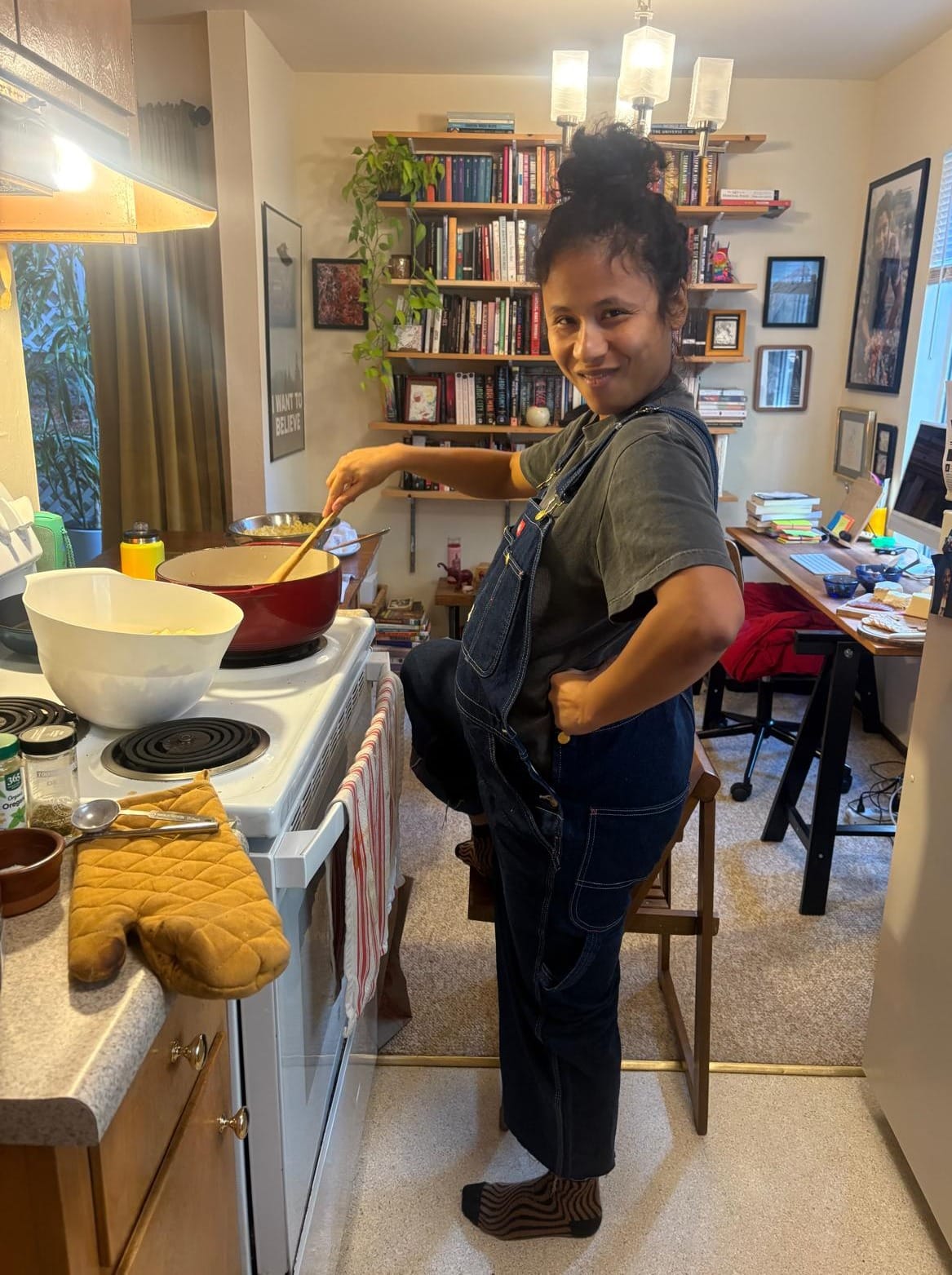
>> I wasn't kidding about cooking up that baby!
Member discussion